"What is the stock market?" is one of those questions kids ask at the worst possible moment, usually in the car, usually when you are not ready with a good answer. The instinct is to wave it off as grown-up stuff. But the stock market for kids is genuinely easy to explain, as long as you start small and skip the jargon.
The trick is to forget the flashing tickers and the nightly news. Underneath all of that noise sits one simple idea: people buying and selling tiny pieces of real companies. Once a child gets that, the rest clicks into place. This guide gives you the words, the analogies, and a couple of no-risk ways to explain stocks to kids so the lesson actually sticks.
Start With One Company, Not the Whole Market
The word "market" makes kids picture something huge and confusing. So do not start there. Start with a single company they already love: the maker of their favorite sneakers, game console, or burger.
Tell them this: a big company is too expensive for one person to own, so it gets sliced into millions of tiny pieces. Each tiny piece is called a share of stock. If you own one share, you own one of those tiny pieces of the whole company. The U.S. Securities and Exchange Commission puts it formally on its investor education site: "A share of stock is an instrument that signifies an ownership position (called equity) in a corporation, and a claim on its proportional share in the corporation's assets and profits."
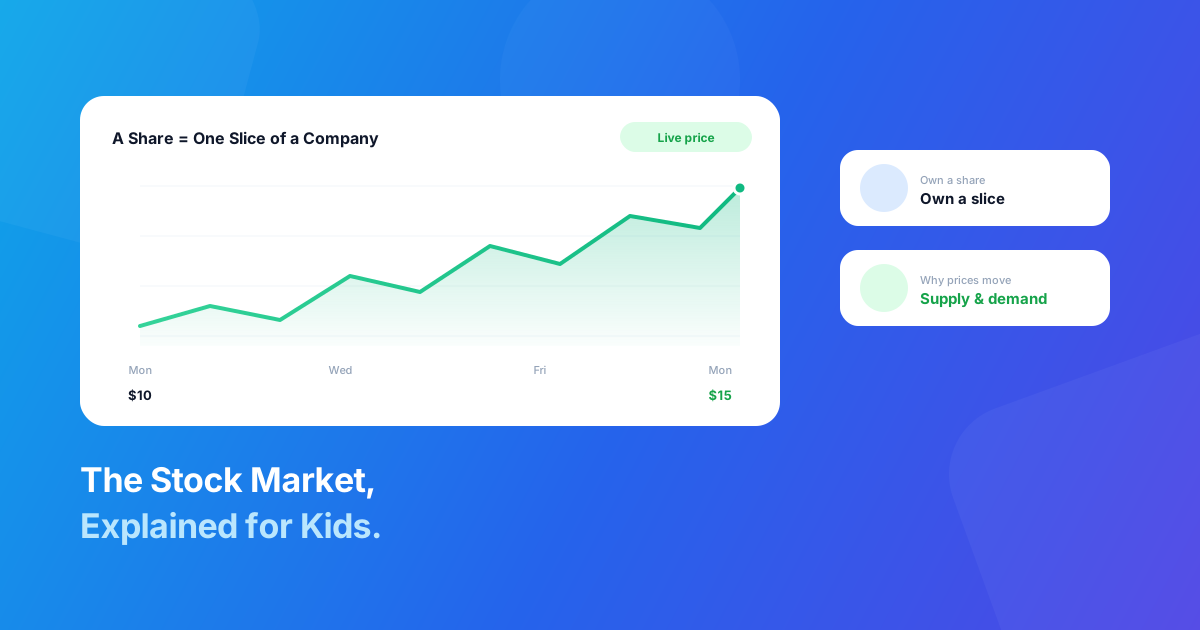
In kid language: own a share, own a slice. If the company does well and grows, your slice can become worth more. If it struggles, your slice can become worth less. That is the whole heart of it.
So What Is the Stock Market, Then?
Once your child understands a single share, the market is the easy part. The stock market is simply the giant marketplace where people buy and sell those slices. Think of a busy farmers market, except instead of trading apples and honey, people trade tiny pieces of companies.
Just like a farmers market has a place where everyone gathers, the stock market has its gathering spots too, called stock exchanges, with famous names like the New York Stock Exchange and the Nasdaq. People do not stand there shouting anymore. Today almost all of it happens through computers in a fraction of a second.
The key point for a kid: nobody sets the price from above. The price of each slice is decided by the crowd, by how many people want to buy versus how many want to sell, all day long.
Why Do Prices Go Up and Down?
This is the question kids find most fascinating, and the answer is two words they can actually grasp: supply and demand.
Use a concert ticket. If a band everyone loves announces one small show, tons of people want the limited tickets, so the price shoots up. If almost nobody wants to go, sellers have to drop the price to find a buyer. Stocks work the same way:
- More buyers than sellers: the price goes up, because people compete to own the slice.
- More sellers than buyers: the price goes down, because owners compete to sell their slice.
What makes the crowd change its mind? News about the company, how much money it earned, a cool new product, or just how hopeful people feel about its future. Because moods and news shift constantly, prices wiggle every single day. That daily wiggle is normal, and learning to ignore it is one of the most valuable habits an investor can build.
What Do You Get for Owning a Share?
Kids will ask, reasonably, "what is the point of owning a slice?" There are two answers, both worth explaining.
First, the slice can grow in value. If you buy a share for $10 and the company becomes more successful, someone might later pay $15 for that same slice. Second, some companies share their profits directly with owners through a payment called a dividend, which the SEC defines as "a portion of a company's profit paid to shareholders." We go deeper on that in our guide to dividends explained for kids.
The big idea over time: companies that keep growing tend to make their slices more valuable, which is why patient, long-term owners have historically done well. A broad basket of large U.S. companies, the S&P 500, has returned about 10% a year on average since 1957, though any single year can swing far higher or lower.
The One Rule Every Young Investor Should Hear
If your child remembers nothing else, have them remember this: do not put all your eggs in one basket. The SEC calls this diversification, "a strategy that can be neatly summed up as 'Don't put all your eggs in one basket.'"
Owning slices of many different companies means that if one stumbles, the others can keep you steady. It is the simplest protection in investing, and it is easy for kids to picture. We explain it in full in our post on diversification for kids.
What to Say at Each Age
Match the explanation to where your child is right now.
- Ages 6 to 8: Stick to "a share is a tiny slice of a company you can own." Use a brand they love. Skip prices entirely.
- Ages 9 to 11: Add the marketplace idea and supply and demand using concert tickets or trading cards.
- Ages 12 to 14: Introduce dividends, long-term growth, and why prices wiggle daily. Show a real price chart.
- Ages 15 and up: Connect it to index funds, diversification, and the value of starting young.
Let Them Practice With Real Prices, Zero Risk
Here is the honest truth: no explanation beats watching a price move with your own money on the line, except a kid should not have real money on the line. That gap is exactly why we built Piggy Bank for Stocks.
In Piggy Bank for Stocks, children buy simulated shares of real companies at real market prices and watch their virtual portfolio rise and fall over days and weeks. They feel supply and demand in action, see the daily wiggle, and learn the hardest lesson of all for free: staying calm when prices dip. Penny the Piggy guides them through the why in short, friendly lessons, so the stock market stops being scary grown-up stuff and starts being a game they understand. For the bigger picture on starting early, see why kids should learn investing early.
The Bottom Line
The stock market is not magic and it is not only for grown-ups in suits. It is a marketplace where people trade tiny ownership slices of real companies, and prices move because crowds change their minds. Explain it one company at a time, use a pizza or a concert ticket, and let your child practice with no risk. A kid who understands ownership, supply and demand, and the value of patience at 10 has a financial head start that will pay off for life.
Sources
- U.S. Securities and Exchange Commission. "Stock" (glossary definition). Investor.gov. investor.gov
- U.S. Securities and Exchange Commission. "Dividend" (glossary definition). Investor.gov. investor.gov
- U.S. Securities and Exchange Commission. "Diversification" (glossary definition). Investor.gov. investor.gov
- Fidelity. "What is the S&P 500 and stock market average return?" (average annual return of about 10% since the index's 1957 launch). fidelity.com
Let Them Trade Real Companies, Zero Risk
Piggy Bank for Stocks turns the stock market into a hands-on game. Real stocks, real prices, no real money at stake. Download Piggy Bank for Stocks and Kids Piggy Bank Management free for iPhone and iPad.
Download Knooty Free