Ask most adults what they wish they had learned earlier about money, and one answer comes up again and again: compound interest. It is the quiet engine behind nearly every story of someone who built wealth slowly and steadily, and it rewards exactly one thing kids have in greater supply than anyone else on earth: time.
The problem is that compound interest sounds like a math lecture. Say "interest compounding annually" to a 10-year-old and watch their eyes glaze over. But the idea underneath it is simple, visual, and genuinely exciting once a child sees it. This guide gives you a clear way to explain compound interest to kids, the one habit that turns the lesson into real money, and the words to use at each age.
Get this one right and you have handed your child the single most valuable money concept there is.
What Is Compound Interest, in Plain English?
Regular growth is when your money earns a little extra and stops there. Compound growth is when that extra also starts earning. The U.S. Securities and Exchange Commission puts it about as simply as it can be put on its investor education site: with compound interest, "you earn interest on the money you save and on the interest that money earns."
That second part is the whole trick. Your money makes money, and then that money makes money too. Each round builds on the last, so the growth speeds up over time instead of staying flat. The longer it runs, the more dramatic it gets, which is why starting young matters so much.
The Snowball: How to Explain Compound Interest to Kids
Forget the formula. The best way to explain compounding to a child is a snowball rolling down a hill.
You start with a snowball the size of your fist. As it rolls, it picks up snow and gets a little bigger. But here is the magic: because it is now bigger, it has more surface touching the snow, so it picks up even more on the next roll. A little snowball gathers a little snow. A big snowball gathers a lot. By the bottom of the hill it is enormous, and it grew fastest right at the end.
Money does the same thing. A small amount earns a small return. That makes it slightly bigger, so the next return is slightly bigger too. Roll it long enough and a modest start becomes a giant snowball. Two things make the snowball bigger: how steep the hill is (the rate of return) and how long the hill is (time). Kids cannot control the hill, but they have more time than anyone. That is their superpower.
The Numbers That Make Kids' Jaws Drop
Once the snowball idea clicks, a couple of real examples turn it into something a child actually feels.
The SEC offers a perfect one. Skip one $1 candy bar a day and save it instead, and that is $365 a year. Invest that money at a 5% return, the SEC notes, and it grows to $465.84 by the end of five years, and to $1,577.50 by the end of 30 years. Same daily dollar. The difference is entirely compounding plus time.
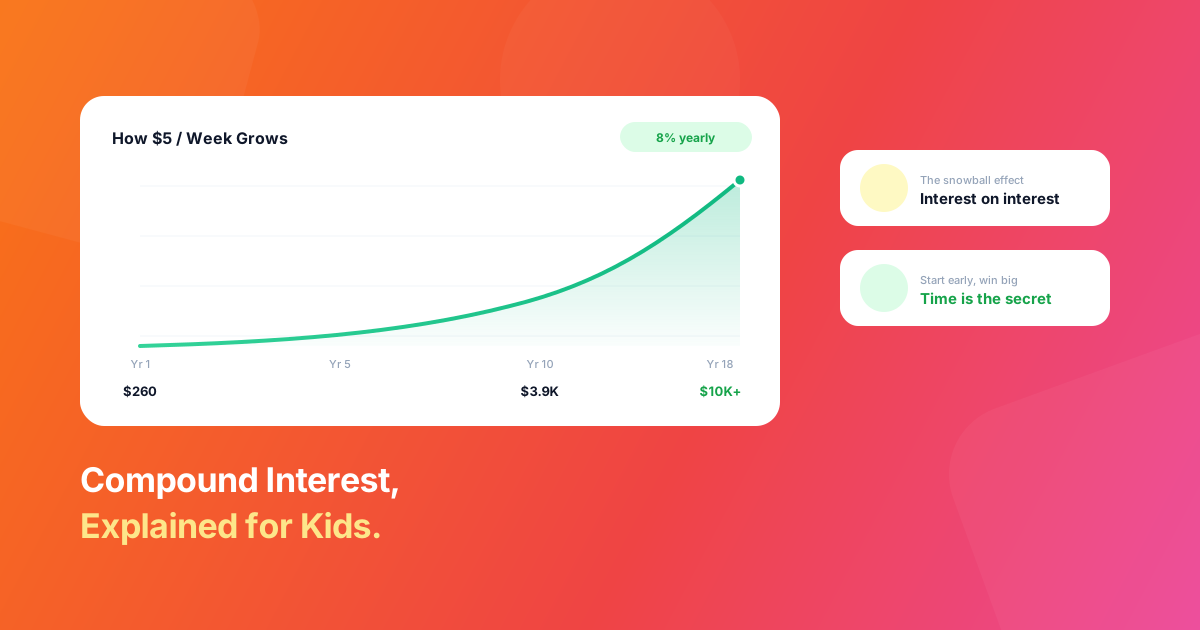
Here is one a kid can run with their own allowance. Imagine saving and investing just $5 a week, about the price of a single snack, and earning a growth rate of 8% a year. (For context, the S&P 500, a broad basket of large U.S. companies, has returned about 10% a year on average since 1957, though any single year can be much higher or lower.) Here is roughly how that $5 snowball rolls:
- After 1 year: about $260, basically just what you put in.
- After 10 years: nearly $3,800, and now the growth is doing real work.
- After 18 years: close to $10,000, from a snack-sized $5 a week.
The point is not the exact dollar figure, which depends on the rate. The point is the shape: the line barely moves at first, then bends sharply upward. That bend is compounding, and the only way to reach it is to start early and stay in.
The Rule of 72: A Magic Trick for the Math
Older kids, roughly ages 11 and up, love a shortcut, and the Rule of 72 feels like one. It answers a question kids find genuinely fun: how long until my money doubles?
Take the number 72 and divide it by the yearly growth rate. The answer is roughly how many years it takes for the money to double.
- At 8% a year: 72 divided by 8 is 9 years to double.
- At 6% a year: 72 divided by 6 is 12 years to double.
- At 12% a year: 72 divided by 12 is 6 years to double.
Hand a child a calculator and let them try their own rates. It turns an abstract idea into a quick, repeatable game, and it quietly teaches two lifelong truths: a higher rate doubles money faster, and time is what lets the doubling happen more than once.
Why Starting Young Is the Real Advantage
Compounding rewards time more than amount, which means a kid's biggest asset is the decades ahead of them. Two extra years of childhood snowball-rolling can outweigh much larger contributions made later, because the early dollars have the longest hill to roll down.
The instinct to plan ahead and wait for a bigger reward is something children build early. A landmark 2013 study by Dr. David Whitebread and Dr. Sue Bingham at the University of Cambridge, commissioned by the UK's Money Advice Service (now MoneyHelper), found that core money "habits of mind," including the ability to plan ahead and delay gratification, are largely formed by age 7. Compound interest is the perfect reason to practice those habits: waiting is no longer just "being good," it is how the snowball gets big.
This is also why we believe in introducing the idea of growing money long before a child has any real money to invest. For more on that case, see our guide on why kids should learn investing early.
What to Say at Each Age
You do not need one perfect speech. You need the right version for where your child is right now.
- Ages 5 to 7: Stick to the snowball and the feeling of waiting. "If we leave your money to grow instead of spending it, it slowly turns into more money." Keep it concrete and short.
- Ages 8 to 10: Introduce "your money makes money, and then that money makes money too." Draw the snowball curve on paper so they see it bend upward.
- Ages 11 to 14: Bring in real numbers, the Rule of 72, and the candy-bar example. This is the age where a chart or a real portfolio makes it stick.
- Ages 15 and up: Connect it to actual investing: index funds, retirement accounts, and why the dollars they save now matter far more than the ones they save at 30.
From Lesson to Habit: Where Knooty Comes In
A chart on the fridge teaches the concept. A habit teaches the skill. The leap from "I understand compound interest" to "I actually let my money grow" is where most adults wish they had practiced as kids.
That is exactly what Piggy Bank for Stocks is built for. Instead of just describing how growth works, kids buy simulated stock in real companies at real market prices and watch a virtual portfolio rise and fall over days, weeks, and months. They feel the bumpy line that a snowball chart smooths over, and they learn the hardest part of compounding for free: staying invested and patient when the market dips. Penny the Piggy walks them through the why behind it in bite-sized lessons, so the math never feels like a lecture.
The Bottom Line
Compound interest is not a hard idea. It is a snowball: small at the top of the hill, unstoppable at the bottom, and it grows fastest right when you think it never will. The math behind it is real, the SEC's own examples prove it, and the one ingredient it demands more than any other is time, which is the one thing your child has the most of.
So roll the snowball. Draw the curve. Run the Rule of 72 on a calculator at the kitchen table. Then give that lesson somewhere to live, whether it is a savings goal, a first index fund, or a practice portfolio. The kid who truly understands compounding at 10 has a head start that almost no amount of catching up later can match.
Sources
- U.S. Securities and Exchange Commission. "Small Savings Add Up to Big Money." Investor.gov. investor.gov
- U.S. Securities and Exchange Commission. "Compound Interest Calculator." Investor.gov. investor.gov
- Fidelity. "What is the S&P 500 and stock market average return?" (average annual return of about 10% since the index's 1957 launch). fidelity.com
- Whitebread, D. & Bingham, S. "Habit Formation and Learning in Young Children." University of Cambridge, commissioned by the Money Advice Service (now MoneyHelper). 2013. moneyhelper.org.uk
Let Them Watch a Real Snowball Grow
Piggy Bank for Stocks turns compound growth from a chart into a hands-on habit. Real stocks, real prices, zero risk. Download Piggy Bank for Stocks and Kids Piggy Bank Management free for iPhone and iPad.
Download Knooty Free