Few parenting decisions feel as quietly loaded as the allowance question. Give too little and it teaches nothing. Give too much and it funds an endless stream of candy and in-app purchases. Tie it to chores and you might accidentally turn helping out into a transaction. Hand it over with no strings and you might raise a kid who expects money to simply appear. No wonder so many families either wing it or skip allowance entirely.
The good news: allowance for kids is one of the most studied corners of family finance, and the research points to a clear, flexible playbook. This guide breaks it into the three questions every parent actually asks: how much, how often, and what to tie it to.
None of this requires a spreadsheet or a finance degree. It just requires a plan you can stick to.
First, Why Allowance Is Worth the Effort
An allowance is the first money a child gets to control. That makes it a low-stakes training ground for the exact skills they will use for the rest of their lives: planning ahead, waiting, choosing between options, and living with the consequences of a decision.
The Consumer Financial Protection Bureau's "Building Blocks" report found that adult financial capability grows from three foundations laid in childhood: executive function, financial habits and norms, and financial knowledge and decision-making skills. The CFPB notes that children begin acquiring these building blocks "as early as preschool" across three stages: early childhood (ages 3 to 5), middle childhood (ages 6 to 12), and the teen and young adult years (ages 13 to 21). A well-run allowance touches all three.
It is also nearly universal. In T. Rowe Price's 14th Annual Parents, Kids & Money Survey (2022), 79% of parents said they give their child an allowance. The disagreements are not about whether to do it. They are about how.
How Much Allowance Should You Give by Age?
There is no universal "correct" number, because the right amount depends on your budget and on what you expect the allowance to cover. But the data gives you useful anchors.
A 2025 study from Wells Fargo, conducted by Ipsos among 1,587 U.S. parents, found that parents give kids ages 5 to 17 an average weekly allowance of about $37. That headline number is high because it blends little kids with teenagers and a handful of very generous households. Look at the distribution instead and a more practical picture emerges: in the T. Rowe Price survey, the single most common weekly amount was $11 to $20 (35% of parents), followed by $6 to $10 (22%) and $21 to $50 (24%).
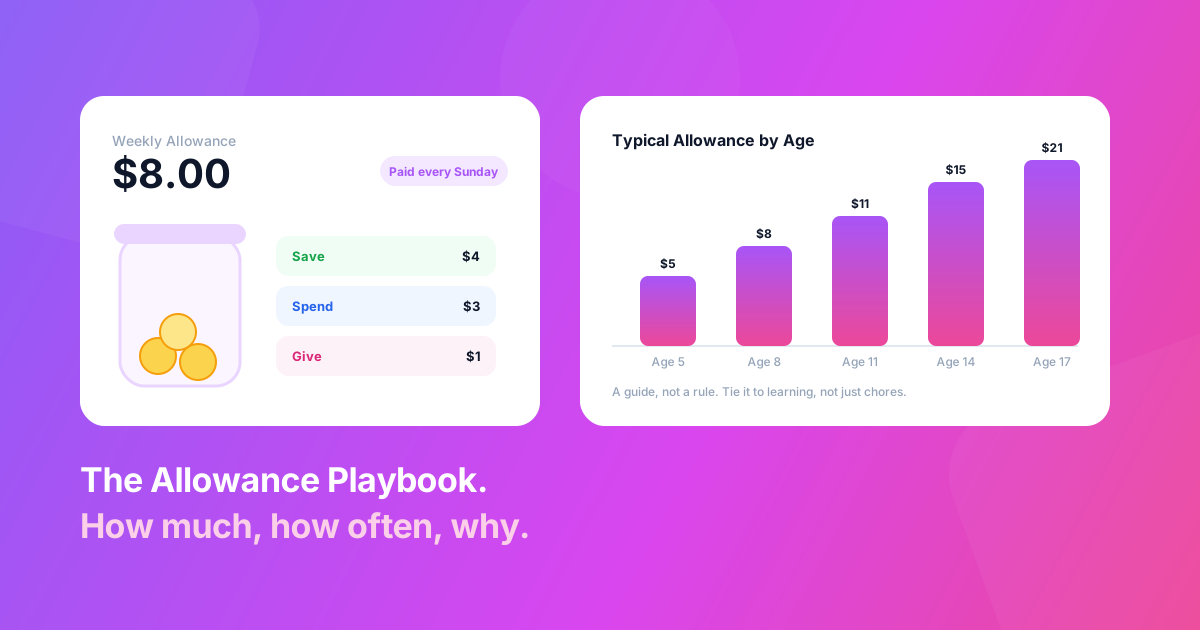
Allowance should also scale with age, because older kids cover more of their own costs. Data from the kids' debit-card company Greenlight (drawn from families on its platform, so treat it as directional rather than nationally representative) shows the pattern clearly: in 2025, 5-year-olds averaged about $6.18 a week, 13-year-olds about $11.59, and 17-year-olds about $21.47.
A few sensible ways to land on your number:
- The dollar-per-year rule. Many families give roughly $1 per week for each year of age. A 7-year-old gets about $7, a 12-year-old about $12. It is easy to remember and scales automatically.
- The "what does it cover" method. Decide what the allowance is responsible for (small treats, an app, a gift for a friend), estimate the real cost, and fund that. As kids age and take on more, the number grows with the responsibility.
- Whatever fits your budget. The teaching value of an allowance comes from how it is used, not from its size. A consistent $5 beats an unpredictable $25.
How Often Should You Pay It?
Frequency matters more than parents expect, because a child's sense of time is so different from an adult's. To a 6-year-old, "next month" might as well be "never." To a 15-year-old, a monthly paycheck is a genuine budgeting challenge worth practicing.
Match the cadence to the stage:
- Ages 5 to 8: weekly. Short, predictable cycles keep the connection between payday and spending tight enough for young kids to grasp. Pick the same day each week and stick to it.
- Ages 9 to 12: weekly or every two weeks. As kids start saving toward bigger goals, slightly longer gaps teach them to hold money across time without losing motivation.
- Ages 13 and up: every two weeks or monthly. Teens benefit from the realistic pressure of making a larger sum last. Running short on day 20 of a 30-day month is a cheap, safe lesson now, rather than an expensive one at 22.
Whatever you choose, the non-negotiable is reliability. A dependable payday is what makes planning possible. If allowance shows up randomly, or gets forgotten, or turns into an on-the-spot negotiation at the store, it cannot teach budgeting because there is no budget to plan around.
Should Allowance Be Tied to Chores?
This is the question that starts arguments at dinner parties, and the honest answer is that thoughtful experts disagree. Both camps have a point.
In the T. Rowe Price survey, parents split clearly: 64% who give an allowance require kids to earn it, while 16% give it with no strings attached (the remaining 21% give no allowance at all). So most families do connect money to effort in some way.
The case for tying it to chores
Linking pay to work mirrors the real world, where money follows effort. Earning your own dollar tends to change how it feels to spend it, and a paid task gives a built-in feedback loop: do the work, get paid; skip it, do not.
The case against tying it to chores
Critics worry that paying for everyday chores can crowd out the simple expectation that family members pitch in. The American Academy of Pediatrics, through its HealthyChildren.org guidance, frames chores first as a way to build "a culture of teamwork in your home" and to teach kids "how to cooperate with a group." It notes that praising effort is the most effective motivator, and treats tangible rewards like allowance as an optional add-on rather than the point.
The middle path most families land on
You do not have to choose a side. A practical hybrid keeps the best of both:
- Baseline chores are unpaid. Making your bed, clearing your plate, and tidying your room are simply part of belonging to the family. No money changes hands.
- A separate, predictable allowance teaches money management. This is the steady amount your child budgets, saves, and learns from, independent of any single chore.
- "Extra" jobs can be paid. Bigger tasks outside the normal routine (washing the car, deep-cleaning the garage, helping with yard work) become optional earning opportunities, so kids who want more money can go get it.
This setup teaches two truths at once: some things you do because you are part of a family, and some money you earn because you chose to work for it. The AAP's age-by-age chore lists, broken into ages 5 to 7, 8 to 10, and 11 to 12, make a handy starting menu for which jobs fall into each bucket.
Turning Allowance Into Real Money Skills
An allowance is the raw material. The skills come from what you build with it. A few habits turn a weekly handout into a genuine financial education:
- Let them make mistakes. If your child blows the whole allowance on day one and has nothing for the thing they wanted on day five, resist the rescue. A $10 regret now is the cheapest tuition they will ever pay.
- Anchor saving to a goal. Saving in the abstract is boring. Saving for a specific $45 game is motivating. Name the goal, track it visibly, and celebrate the purchase.
- Do not bail out impulse buys. If they want it, they wait and save for it. Delayed gratification is a muscle, and the allowance is the gym.
- Talk about it weekly. A two-minute check-in beats a lecture. "What did you spend on? What are you saving toward?" keeps money a normal, ongoing conversation.
That last habit is the multiplier. Frequent, low-key money conversations are among the strongest predictors of a financially capable adult, which is why we wrote a whole guide on the 5 money conversations every parent should have with their kids. Allowance gives those conversations something concrete to be about.
Where Investing Fits In
Once a tween is reliably saving part of their allowance, you can introduce the idea that money does not have to sit still: it can grow. That is the leap from saving to investing, and it is the one with the biggest long-term payoff.
Abstract talk about compound growth rarely lands with a 12-year-old, which is exactly why we built Piggy Bank for Stocks. Instead of just explaining how owning a piece of a company works, kids buy simulated stock in real companies at real market prices, watch a virtual portfolio rise and fall, and build emotional discipline without risking a cent. A small slice of the "Save" jar can become their first practice investment. For the why behind starting young, see our guide on why kids should learn investing early.
The Bottom Line
There is no perfect allowance number, schedule, or chore policy, and chasing one is a trap. What the research consistently rewards is structure and consistency. Pick an amount you can sustain (the dollar-per-year rule or a $5 to $20 weekly range is a fine place to start). Pay it on a predictable schedule that fits your child's age. Decide deliberately whether chores are family duties, paid jobs, or a clear mix of both, and write it down.
Then do the part that actually teaches: let your child control the money, make small mistakes, save toward goals they care about, and talk it through with you week after week. That is how an allowance stops being a candy fund and starts becoming the first chapter of a lifelong money education.
Sources
- Wells Fargo. "New Wells Fargo Study Shows Parents Give Their Kids an Average Weekly Allowance of $37." Survey conducted by Ipsos, July 2, 2025. newsroom.wf.com
- T. Rowe Price. "14th Annual Parents, Kids & Money Survey: Detailed Results." Fielded January 7 to February 3, 2022 (n=2,138 parents and children ages 8 to 14). moneyconfidentkids.com
- Consumer Financial Protection Bureau. "Building blocks to help youth achieve financial capability: A new model and recommendations." 2016. consumerfinance.gov
- American Academy of Pediatrics. "Age-Appropriate Chores for Children." HealthyChildren.org. healthychildren.org
- Greenlight. "Average weekly allowance by age for kids and teens" (2025 platform data). greenlight.com
Give Their Allowance Somewhere Smart to Grow
Piggy Bank for Stocks turns part of that weekly allowance into a hands-on investing lesson. Real stocks, real prices, zero risk. Download Piggy Bank for Stocks and Kids Piggy Bank Management free for iPhone and iPad.
Download Knooty Free