Most parents would rather have "the talk" about almost anything before they have "the money talk." T. Rowe Price's Parents, Kids & Money Survey has repeatedly found that parents are more comfortable discussing bullying, drugs, and even puberty than they are talking about investing and family finances. And yet the research is clear: the conversations a parent has with their child about money are one of the strongest predictors of that child's financial literacy later on.
You don't need a finance degree. You don't need a spreadsheet. You just need to start talking.
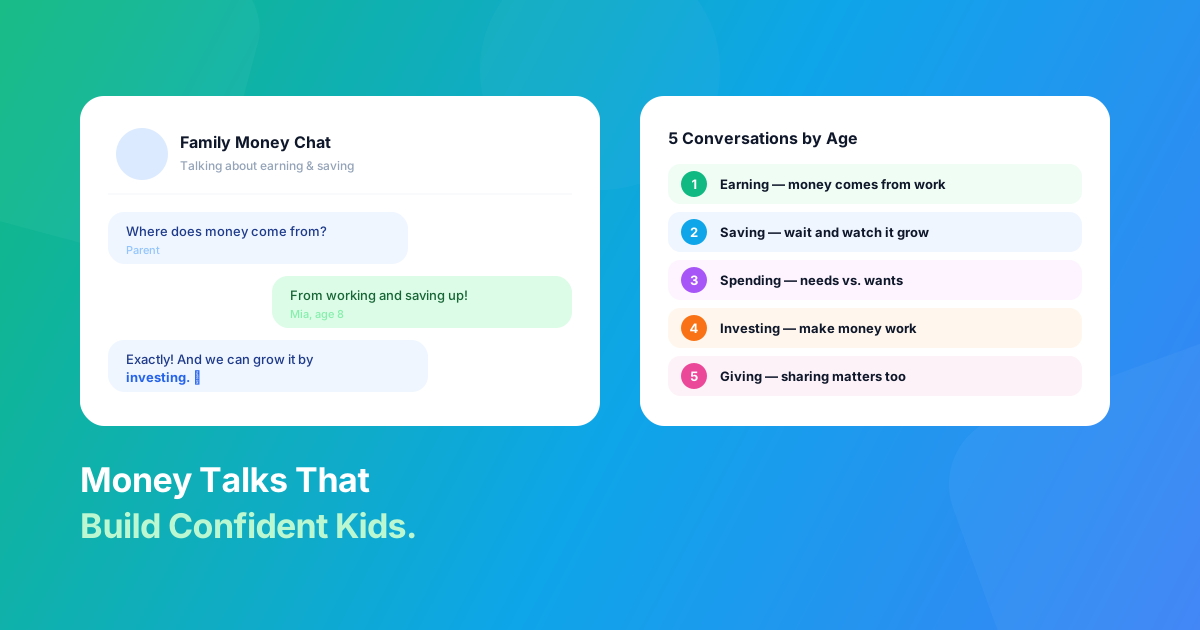
Here are the five essential money conversations every parent should have with their kids: what to say, when to say it, and why each one matters more than most parents realize.
Why the Conversation Matters More Than the Content
Before we get into the five conversations, the headline finding from decades of research is worth sitting with. The OECD PISA 2022 financial literacy assessment of 15-year-olds across 20 countries and economies found that students who discuss their saving or purchasing decisions with their parents (68% do so at least once a month) are much more financially literate than peers who don't.
The Consumer Financial Protection Bureau's (CFPB) "Building Blocks" research reaches the same conclusion from a different angle: financial capability in adults is built from three foundations laid in childhood: executive function, financial habits and norms, and financial knowledge and decision-making skills. All three are shaped by the small, everyday conversations kids have with the adults in their lives.
And according to a landmark 2013 University of Cambridge study commissioned by the UK's Money Advice Service (now MoneyHelper), children's core money habits are already formed by age 7. The window for shaping financial intuition is earlier than most parents realize.
Conversation 1: Needs vs. Wants (Ages 3–7)
This is the foundation, and it's never too early to start. The CFPB's "Money as You Grow" framework recommends introducing the idea of needs versus wants as early as preschool. A need is something you have to have to live: food, a place to sleep, clothes that fit. A want is something that would be nice, but you can live without it.
The trick at this age is not a lecture. It's a question. At the grocery store: "Is this cereal a need or a want?" Before a birthday: "Is the new Lego set a need or a want? How do you know?" The goal is to plant the distinction so kids start applying it on their own.
Why it matters: the CFPB's Money as You Grow guidance for young children emphasizes that this age is when kids start building executive function: the ability to plan ahead, delay gratification, resist impulses, and solve problems. Those capacities, not specific financial knowledge, are what predict strong money decisions later in life.
Conversation 2: Earning and the Value of Work (Ages 6–10)
By the time kids start elementary school, they're ready to understand that money doesn't just appear in a wallet. It comes from work. This is the conversation where many parents accidentally undermine themselves by using the "we can't afford it" shortcut. A better reframe, popularized in family-finance books like Smart Money Smart Kids, is: "That's not in the budget we chose." It teaches agency, not scarcity.
Key ideas to get across:
- Money is exchanged for work. People earn money by doing things that are valuable to other people. Different jobs pay different amounts based on skill, risk, and demand.
- Families have a budget. A budget is a plan for where money goes. We choose to spend on some things and not others.
- Kids can earn too. Whether through an allowance, extra chores, a lemonade stand, or shoveling a neighbor's driveway, earning your own money changes how it feels to spend it.
This matters beyond the paycheck: the OECD's PISA 2022 financial literacy data also found that high performers in financial literacy are 72% more likely than low performers to save money and 50% more likely to compare prices in different shops before buying. Those habits often start with kids learning what their own earned dollar is worth.
Conversation 3: Saving for a Goal and the Magic of Waiting (Ages 7–12)
This is the conversation that builds one of the most valuable financial traits: delayed gratification. The famous Stanford "marshmallow test," along with a 40-year follow-up study published in PNAS (Casey et al., 2011), found that people who had shown stronger self-control as preschoolers still showed it four decades later, with measurable differences in the brain circuits that govern impulse control.
The good news: delayed gratification is teachable. And a savings goal is one of the most effective ways to teach it.
Pick something your child genuinely wants: a Lego set, a game, a pair of shoes. Don't buy it for them. Instead, sit down together and:
- Name the goal. Write it down. Make it concrete: "$45 for the new Switch game."
- Make a plan. If they earn $5 a week, how many weeks until they have $45? (Nine.) Would they rather have it faster? How?
- Track progress visibly. A clear jar, a paper thermometer, or a tracker app. Seeing progress is the fuel that keeps kids motivated.
- Celebrate the buy. When they hit the goal, make a ceremony of it. They'll remember that feeling more vividly than any lecture about the power of saving.
Drs. David Whitebread and Sue Bingham of the University of Cambridge concluded in their 2013 report for the UK Money Advice Service that "the 'habits of mind' which influence the ways children approach complex problems and decisions, including financial ones, are largely determined in the first few years of life," a finding that has reshaped how experts think about early financial education.
Conversation 4: Smart Spending and Advertising Awareness (Ages 9–14)
Kids are bombarded with ads. According to Common Sense Media's 2021 Census, tweens (ages 8–12) average roughly five and a half hours of screen media a day and teens over eight and a half, most of it ad-supported across YouTube, TikTok, games, and streaming. Many of those ads are optimized by sophisticated algorithms to bypass rational thought and hit directly at impulse. Teaching media and advertising literacy is now one of the most important money skills a parent can pass on.
Make this a conversation, not a sermon. Next time an ad plays:
- "Who made this ad, and what do they want you to do?" Every ad has a goal, usually to get you to spend. Naming it takes away some of its power.
- "What feeling is this ad trying to create?" Fear of missing out. Envy. Insecurity. Excitement. Kids who can name the emotion are less controlled by it.
- "Is this a need, a want, or a want the ad just created in you?" This question ties directly back to Conversation 1. It's the same framework, leveled up.
Also introduce the concept of the unit price, comparing options, and the idea of "total cost" (including shipping, taxes, and subscriptions). Pre-teens love feeling like insiders, and teaching them how pricing tricks work makes them feel one step ahead of the companies trying to sell to them.
Conversation 5: Investing, Ownership, and Compound Growth (Ages 11+)
This is the conversation most parents skip, and it's the one that gives kids the biggest long-term advantage. By middle school, kids are ready to grasp that money can grow when it's invested, and that owning a piece of a company (a stock) is how ordinary people have historically built wealth over generations.
Start with what they already know. Almost every brand in your child's life (Apple, Nike, Nintendo, Disney, Netflix, the company that makes their favorite cereal) is publicly traded. "You know how you love your iPhone? There's a way ordinary people can own a tiny piece of Apple, and when the company does well, their tiny piece is worth more." That one sentence often unlocks a completely new way of seeing the world.
Then introduce the idea that changed everything for every successful investor: compound growth. The classic example still works:
- $100 invested at 10% for one year becomes $110. You earned $10.
- $100 invested at 10% for 30 years becomes over $1,700. You earned $1,600+, without adding another dollar.
- The same $100 invested at age 10 vs. age 30 can be the difference between $4,500 and $760 by retirement. Time is the secret ingredient, not size.
This is abstract for a 12-year-old to imagine, which is exactly why we built Piggy Bank for Stocks. Instead of just explaining compound growth, kids can see it: buying simulated stock in real companies with real market prices, watching their virtual portfolio grow (and sometimes drop), and learning emotional discipline without risking real money. Pair it with our deeper article on why kids should learn investing early for a full picture of why this conversation matters.
Putting It All Together: The Weekly Money Check-In
You don't have to do all five conversations this weekend. The point isn't any single talk. It's the cadence. Weekly, even briefly, in the car or at the dinner table, is all it takes.
Here's a simple framework to keep going:
- Open with an observation, not a lesson. "I noticed you saved up for that game. How did it feel when you finally bought it?"
- Use real-life moments as the curriculum. The grocery store, the restaurant tip, the streaming subscription, the news story about a company. Money is everywhere, and you're just pointing it out.
- Let them ask the questions. A kid asking "why do rich people stay rich?" at age 9 is gold. Answer honestly, even if the answer is "great question, let's look it up together."
- Share your own process. Kids learn more from watching you decide than from hearing you preach. Narrate a real decision: "I'm choosing to skip the upgrade because we're saving for vacation."
- Follow their lead when they bring it up. When a child walks in the door excited about their Knooty portfolio or curious about a stock, drop what you're doing. Those moments build lifetime habits.
The Bottom Line
The best financial education your child will ever receive isn't a course, a book, or even an app. It's the ongoing conversation they have with the adults they trust most. Research from the OECD, the CFPB, Cambridge, and T. Rowe Price all points to the same conclusion: frequent, age-appropriate money talks are among the strongest predictors of financial literacy in adulthood. And unlike almost every other parenting variable, this one is largely within your control.
Start small. Pick one of the five conversations above: the one that fits your child's age and where you've been most quiet. Try it this week. Then try another next week. Before long, "the money talk" stops being a single dreaded event and becomes something better: a steady, curious, open dialogue that will shape every financial decision your child makes for the rest of their life.
And if you'd like a little help turning the lessons into something your kid genuinely wants to engage with, meet our friendly piggy co-teacher in "How Penny the Piggy Makes Finance Fun for Kids". She's been waiting to help.
Sources
- OECD. "PISA 2022 Results (Volume IV): How Financially Smart Are Students?" OECD Publishing, 2024. oecd.org
- Consumer Financial Protection Bureau. "Building blocks to help youth achieve financial capability: A new model and recommendations." 2016. consumerfinance.gov
- Consumer Financial Protection Bureau. "Money as You Grow: help for parents and caregivers." consumerfinance.gov
- Consumer Financial Protection Bureau. "Money as You Grow: Young children (ages 3–5)." consumerfinance.gov
- Whitebread, D. & Bingham, S. "Habit Formation and Learning in Young Children." University of Cambridge, commissioned by the Money Advice Service (now MoneyHelper), May 2013.
- T. Rowe Price. "14th Annual Parents, Kids & Money Survey Results," 2022. moneyconfidentkids.com
- Casey, B. J., Somerville, L. H., Gotlib, I. H., Ayduk, O., Franklin, N. T., Askren, M. K., Jonides, J., Berman, M. G., Wilson, N. L., Teslovich, T., Glover, G., Zayas, V., Mischel, W., & Shoda, Y. "Behavioral and neural correlates of delay of gratification 40 years later." Proceedings of the National Academy of Sciences, 108(36), 14998–15003, 2011. pnas.org
- Common Sense Media. "The Common Sense Census: Media Use by Tweens and Teens, 2021." commonsensemedia.org
- Ramsey, D. & Cruze, R. Smart Money Smart Kids. Ramsey Press, 2014. ramseysolutions.com
Turn Money Talks Into Money Habits
Piggy Bank for Stocks makes the fifth conversation, investing, easy, safe, and genuinely fun for your child. Real stocks, real prices, zero risk. Download free for iPhone and iPad.
Download Knooty Free