Ask any parent about their biggest challenge in teaching kids about money and you'll hear a familiar refrain: "They just zone out." Worksheets don't work. Lectures last about thirty seconds. And handing a ten-year-old a book about compound interest? Good luck.
But what if financial education felt less like homework and more like a game? What if there was a friendly guide, a system of rewards, and a sense of adventure that made kids want to learn about investing?
That's exactly what gamification does. And the research behind it is surprisingly powerful.
What Is Gamification, and Why Does It Work?
Gamification is the application of game-design elements (points, levels, badges, quests, leaderboards) to non-game contexts like education. It's the reason Duolingo has over 128 million monthly users learning languages, and it's the same psychology that keeps kids engaged in their favorite video games for hours.
But this isn't just a Silicon Valley trick. A comprehensive 2024 systematic review of 90 gamification interventions published in Frontiers in Education found that gamification consistently enhances student participation, interest, confidence, and academic performance, particularly in structured subjects like mathematics and science.
And when applied specifically to finance? A 2024 randomized controlled trial involving 2,220 students across four countries found that game-based financial education significantly improved financial literacy scores by 0.313 standard deviations, a meaningful effect achieved through play rather than traditional instruction.
The Science: Why Kids' Brains Are Wired for Game-Based Learning
To understand why gamification is so effective with children, you need to understand two things: how reward systems work in developing brains, and what psychologists call Self-Determination Theory.
The Dopamine Connection
When a child earns XP for completing a lesson or unlocks a new badge, their brain releases dopamine, the same neurotransmitter associated with pleasure, motivation, and memory formation. Research published in Frontiers in Human Neuroscience has shown that this dopamine release during game-like activities is associated with increased activity in the ventral striatum, a brain region central to reward processing and the acquisition of learning.
This isn't just about feeling good. Studies show that extrinsic rewards presented during the learning process foster the storage of newly learned information into long-term memory. The emotional engagement of game elements makes lessons stick in a way that passive reading simply can't match.
Autonomy, Competence, and Relatedness
Psychologists Edward Deci and Richard Ryan's Self-Determination Theory (SDT) identifies three innate psychological needs that drive sustained motivation: autonomy (feeling in control of your choices), competence (feeling capable and seeing progress), and relatedness (feeling connected to others).
Well-designed gamification satisfies all three. A 2024 study in TechTrends found that gamification elements need to support all three psychological factors, and that there may even be negative effects when they don't. This is the difference between gamification that transforms learning and gamification that feels like a cheap gimmick.
"Both intrinsic motivation and well-internalized forms of extrinsic motivation predict positive outcomes across varied educational levels and cultural contexts, and are enhanced by supports for students' basic psychological needs."
Ryan & Deci, Self-Determination Theory, American Psychologist (2000)
Meet Penny the Piggy: Your Child's Financial Guide
Piggy Bank for Stocks didn't just slap some badges onto a textbook and call it gamification. Every element was designed with these research principles in mind, starting with the most important one: a guide kids actually want to learn from.
Penny the Piggy is Knooty's mascot and learning companion. She introduces herself in the very first lesson with characteristic warmth: "Hi there! I'm Penny the Piggy! When I was a little piggy, I learned something amazing: money isn't just coins and paper. It's a tool that helps you get what you want and make your dreams come true!"
Research on mascot characters and children shows that kids predominantly perceive mascots as funny, tender, and engaging, characteristics that establish a strong emotional bond. That bond serves a crucial purpose: it transforms an abstract subject (investing) into a personal relationship. Kids aren't just studying finance. They're going on an adventure with Penny.
The Five Game Mechanics That Make It Work
Piggy Bank for Stocks uses five interconnected gamification mechanics, each grounded in learning science. Here's how they work together:
1. Progressive Levels (The Scaffolding Principle)
Knooty's curriculum spans 10 levels with 70 lessons, progressing from "What is money?" to concepts like diversification, market cycles, and reading financial statements. This progressive structure mirrors what psychologist Lev Vygotsky called the Zone of Proximal Development (ZPD): the sweet spot where material is challenging enough to promote growth but not so difficult that it causes frustration.
Video game designers are experts at this principle. Players learn controls and narrative through playing as difficulty increases gradually, keeping them engaged for hours by preventing boredom while providing just enough support to prevent frustration. Knooty applies the same approach: each lesson builds on the last, and kids must pass quizzes (scoring 80% or higher) before unlocking the next lesson. It's challenging, but achievable. That's exactly where learning happens fastest.
2. XP and Leveling Up (Visible Competence)
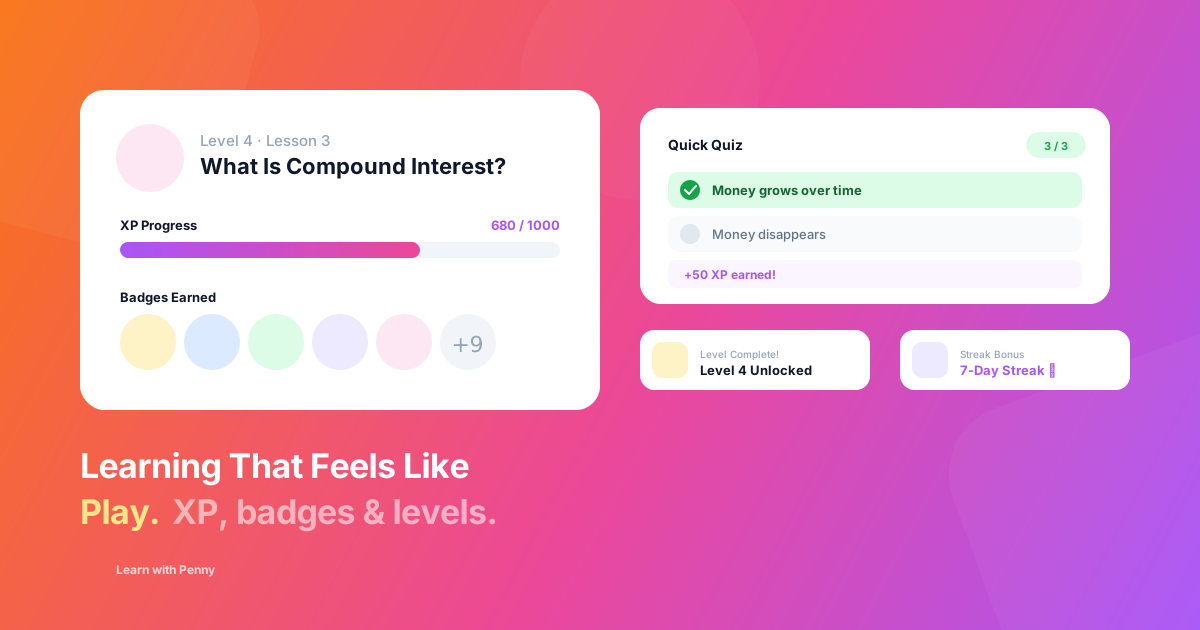
Every completed lesson earns 10-15 XP (experience points). Every completed level awards a 25 XP bonus. This constant stream of visible progress directly addresses the competence need from Self-Determination Theory.
XP isn't just a number. It's concrete evidence that a child is getting smarter about money. When a kid sees their XP climb from 0 to 50 to 200, they can see their knowledge growing. Research on gamification in education confirms that this visible progress is a powerful motivator, far more effective than vague assurances that "you're doing great."
3. Badges and Achievements (Milestone Recognition)
Knooty features 15 badges and 50 achievements across five categories (trading, performance, learning, milestones, and special achievements). Each one marks a genuine accomplishment:
- Money Explorer: mastered the basics of money, earning, saving, and needs vs. wants
- Investor Basics: understands stocks, risk, reward, and diversification
- Streak Warrior: completed lessons for 5 consecutive days
- Quiz Master: scored 100% on 10 different quizzes
- Junior Investor Pro: graduated all 10 levels as a certified Junior Investor
Research from Duolingo's own data shows that badges boost course completion rates by 30%. But the key insight from education research is how badges work. A 2023 study in Computers and Education Open found that badges are most effective when they serve as informational feedback (evidence of competence and progression toward mastery) rather than controlling mechanisms. Knooty's badges are designed this way: they celebrate what a child knows, not just what they clicked.
4. Quizzes and Active Recall (The Testing Effect)
Every Knooty lesson ends with a quiz of 3-5 questions. This isn't assessment for assessment's sake. It's one of the most effective learning strategies ever studied.
Cognitive scientists call it the testing effect (or retrieval practice). A meta-analysis by Rawson and Dunlosky found that the benefits of quizzing outweigh the benefits of other study activities such as re-reading and homework. When kids actively retrieve information to answer a quiz question, they strengthen the neural pathways for that knowledge far more than passively reviewing content.
Knooty's quizzes also provide immediate, encouraging feedback through Penny: "Exactly! Money is a powerful tool that helps you reach your goals and make your dreams happen!" This feedback loop (answer, learn, move forward) keeps the learning cycle tight and rewarding.
5. Streaks and Family Leaderboards (Consistency and Connection)
Knooty rewards learning streaks (consecutive days of completing lessons) and features a family leaderboard where siblings can see each other's progress. This addresses the third SDT need: relatedness.
The power of streaks is well-documented. Duolingo reports that users who maintain a streak for 7 days are 3.6x more likely to stay engaged long-term. And family leaderboards turn financial education into a shared family activity, creating the organic, meaningful conversations about money that OECD PISA data shows are strongly associated with higher financial literacy in young people.
The Gamification Trap, and How Knooty Avoids It
Not all gamification is created equal. Poorly designed systems can actually undermine learning.
A study published in Health Education & Behavior found that when children received points regardless of effort quality, they learned to "beat the system" by exerting minimal effort for maximum rewards. The engagement spike was short-lived, and the underlying motivation never developed. The 2024 Frontiers in Education systematic review echoed this concern: motivation gained through gamification "is not synonymous with academic success," and students sometimes struggle to apply gamified learning in other contexts.
Knooty is designed to avoid these traps:
- Rewards require real understanding. You can't earn XP by clicking through lessons. You need to pass a quiz with 80% or higher. The reward follows genuine comprehension.
- Badges reflect knowledge, not clicks. Badges like "Risk Ranger" (90%+ on all Level 5 and 6 quizzes) and "Quiz Master" (perfect scores on 10 quizzes) can only be earned through demonstrated mastery.
- Progressive unlock prevents shortcuts. Kids must pass each lesson to unlock the next. There's no way to skip ahead to earn badges faster. The learning is the path.
- The real reward is the simulation. Completing lessons unlocks deeper understanding that kids apply in Knooty's simulated stock trading. When a child who's learned about diversification then diversifies their simulated portfolio and watches it outperform, the gamification loop closes with real insight, not just a badge.
What the Numbers Say About Financial Education and Kids
The urgency of getting financial education right is clear from the data. The OECD's PISA 2022 financial literacy assessment (the most rigorous international benchmark) found that across 14 OECD countries, 18% of 15-year-olds lack even basic financial proficiency. They cannot apply what they know to real-life financial decisions.
But the same data revealed something hopeful: students who had been exposed to financial tasks in school performed significantly better. And students who discussed saving and purchasing decisions with their parents at least monthly scored markedly higher. The challenge isn't whether financial education works. It's making it engaging enough that kids actually participate.
That's where gamification bridges the gap. A 2024 study on gamified financial education found that 91% of students expressed strong interest in learning financial concepts through gameplay, and participants showed improvements in both financial knowledge and analytical decision-making skills.
A Day in a Kid's Learning Journey
Here's what gamified financial education actually looks like in practice with Knooty:
Morning: 10-year-old Maya opens Knooty and sees she's on Level 3, Lesson 2. Penny greets her and introduces the topic: how entrepreneurs earn money. The lesson takes 3 minutes to read: short, illustrated, full of relatable examples.
Quiz time: Maya answers 4 questions. She gets 3 right on the first try, misses one, reads Penny's explanation ("Not quite! Remember, an entrepreneur is someone who starts their own business..."), and retakes. She passes with 100% and earns 12 XP.
The unlock: A badge notification appears: "Generous Earner" for completing Level 3. She sees herself climb the family leaderboard, now ahead of her brother. She messages him: "I'm winning!"
The connection: At dinner, Maya tells her parents about entrepreneurs. Her dad mentions that the coffee shop they went to last weekend is a small business. A real conversation about money happens, not because anyone forced it, but because Maya is genuinely excited about what she learned.
That cycle (learn, quiz, reward, apply, discuss) is gamification at its best. No screen-time guilt. No bored stares. Just a kid who's building financial literacy because it's fun.
The Bottom Line
Gamification isn't a gimmick. When designed well, with progressive difficulty, meaningful rewards, active recall, and social connection, it's one of the most effective approaches to education we have. The research is clear: game-based financial education produces real, measurable gains in financial literacy. And it works precisely because it meets kids where they are: in a world where engagement is earned, not demanded.
Penny the Piggy isn't just a cute mascot. She's the bridge between "ugh, money is boring" and "Mom, did you know that when you buy a stock you own a piece of a real company?" She guides, encourages, quizzes, and celebrates, turning every lesson into a step in an adventure that kids choose to take.
Because the best financial education isn't the kind that's most rigorous or most comprehensive. It's the kind kids actually complete. And with the right gamification, they don't just complete it. They can't wait for the next lesson.
Sources
- Amagir, A., Groot, W., Maassen van den Brink, H. & Wilschut, A. "The impact of an online game-based financial education course: Multi-country experimental evidence." Journal of Economic Psychology, 2024. sciencedirect.com
- Almeida, F. & Cunha, P. "Impact of gamification on school engagement: A systematic review." Frontiers in Education, Vol. 9, 2024. frontiersin.org
- Ryan, R. M. & Deci, E. L. "Self-Determination Theory and the Facilitation of Intrinsic Motivation, Social Development, and Well-Being." American Psychologist, 55(1), 68-78, 2000. selfdeterminationtheory.org
- Bovermann, K. & Bastiaens, T. J. "Advancing Gamification Research with Three Underexplored Ideas in Self-Determination Theory." TechTrends, 2024. springer.com
- Howard, M. C. "Gamification in education and training: A literature review." International Review of Education, 2024. springer.com
- Ahn, S. J., Johnsen, K. & Ball, C. "Points-Based Reward Systems in Gamification Impact Children's Physical Activity Strategies and Psychological Needs." Health Education & Behavior, 46(3), 417-425, 2019. pmc.ncbi.nlm.nih.gov
- Kühn, S. et al. "Playing Super Mario induces structural brain plasticity and dopamine release." Frontiers in Human Neuroscience, 2014. pmc.ncbi.nlm.nih.gov
- Rawson, K. A. & Dunlosky, J. "Spaced Repetition Promotes Efficient and Effective Learning." Policy Insights from the Behavioral and Brain Sciences. researchgate.net
- OECD. "PISA 2022 Results (Volume IV): How Financially Smart Are Students?" OECD Publishing, 2024. oecd.org
- Garneli, V., Sotides, C. & Vassilakis, K. "Gamification in Enhancing Student Financial Knowledge, Engagement, and Enjoyment in Financial Education." 2024. researchgate.net
- Vygotsky, L. S. "Zone of Proximal Development." Overview via Simply Psychology. simplypsychology.org
- Manero, B., Torrente, J. & Fernandez-Manjon, B. "From badges to boss challenges: Gamification through need-supporting scaffolded design." Computers and Education Open, 2023. sciencedirect.com
Ready to Let Your Child Learn with Penny?
70 lessons, 15 badges, 50 achievements, and one very enthusiastic piggy. Download Piggy Bank for Stocks free for iPhone and iPad.
Download Knooty Free